The CNC machinist shortage is no longer a future risk. It is already constraining throughput, lead times and growth across US machine shops.
As of December 2025, U.S. manufacturing had 433,000 job openings. Longer term, Deloitte and The Manufacturing Institute project that up to 2.1 million manufacturing jobs could go unfilled by 2030 if the skills gap persists. At the same time, training a CNC programmer to real shop-floor proficiency can take years, not weeks: apprenticeship pathways commonly run 3 to 4 years, and accelerated CNC programmer programs can require 4,000 hours of structured training over 2 years.
That combination creates a simple business problem: demand moves faster than the talent pipeline.
For many shops, the practical question is no longer “How do we hire more people?” It is “How do we produce more parts with the skilled team we already have?”
That is where AI CAM software changes the equation.
Why the CNC machinist shortage is still getting worse in 2026
The labor shortage in manufacturing is not just about headcount. It is a skills bottleneck concentrated in the exact roles that keep spindles turning: CAM programmers, experienced setup staff, process engineers and multi-axis machinists.
When those roles are hard to fill, shops feel the impact everywhere:
- Quotes take longer to turn around
- Programming queues get longer
- Senior programmers become bottlenecks
- New hires take too long to reach full productivity
- Overtime rises while margins tighten
- Capacity is limited even when machines are available
This is why the machinist shortage has become one of the biggest drivers of AI adoption in machining. Shops do not need software because software is fashionable. They need it because expert programming time is scarce and expensive.
The hidden cost of waiting for hiring to catch up
A common response to the skills gap is to double down on recruitment, apprenticeships and retention. Those matter. But they do not solve the near-term capacity problem on their own.
Even strong workforce programs take time to pay off. NTMA points to registered machining apprenticeships that run 3 to 4 years, while AJAC’s CNC Programmer apprenticeship spans 2 years and 4,000 hours.
That means every shop leader is balancing two different clocks:
- The business clock: customer demand, delivery pressure and revenue targets.
- The training clock: the time it takes to build real programming capability.
Those clocks rarely match.
If your best programmers are overloaded today, hiring alone will not remove the bottleneck soon enough. You need a way to make existing programmers more scalable right now.
How AI CAM software bridges the skills gap
AI CAM software helps shops increase output without increasing specialist headcount at the same rate.
Instead of relying on every toolpath and strategy being created manually from scratch, AI can accelerate large portions of the repetitive programming work that consumes expert time. That lets experienced programmers focus on higher-value decisions such as part strategy, process optimization, setup risk and production improvement.
In practice, AI CAM software helps bridge the skills gap in five ways:
1. It reduces the amount of expert time needed per part
When programming work is partially automated, one programmer can handle more jobs in the same amount of time. That directly eases the impact of an understaffed team.
2. It shortens the ramp for less-experienced programmers
AI does not replace machining knowledge. But it can help less-experienced users produce usable starting points faster, with more consistency, while they continue to learn.
3. It captures best practices more consistently
A major skills-gap problem is that too much knowledge lives in the heads of a few senior people. AI-driven CAM workflows help standardize parts of the process so output is less dependent on tribal knowledge.
4. It improves throughput without requiring immediate hiring
If you cannot hire a seasoned multi-axis programmer this quarter, the next best outcome is enabling your current team to take on more work confidently.
5. It supports growth without linear headcount growth
Shops that grow by adding more machines still hit a ceiling if programming capacity does not grow too. AI helps remove that mismatch.
Why this matters for CNC shops specifically
The bottleneck is not usually that shops lack machines. It is that they lack enough experienced people to keep those machines fully utilized.
Programming complexity has also increased. More part variation, tighter lead times and more advanced machining strategies mean CAM teams are under pressure to do more with less.
That is why the most practical response to the CNC skills gap is not “replace machinists.” It is “amplify the people you already have.”
AI CAM software is best understood as a force multiplier for scarce expertise.
Where CAM Assist fits
CAM Assist is designed for exactly this environment.
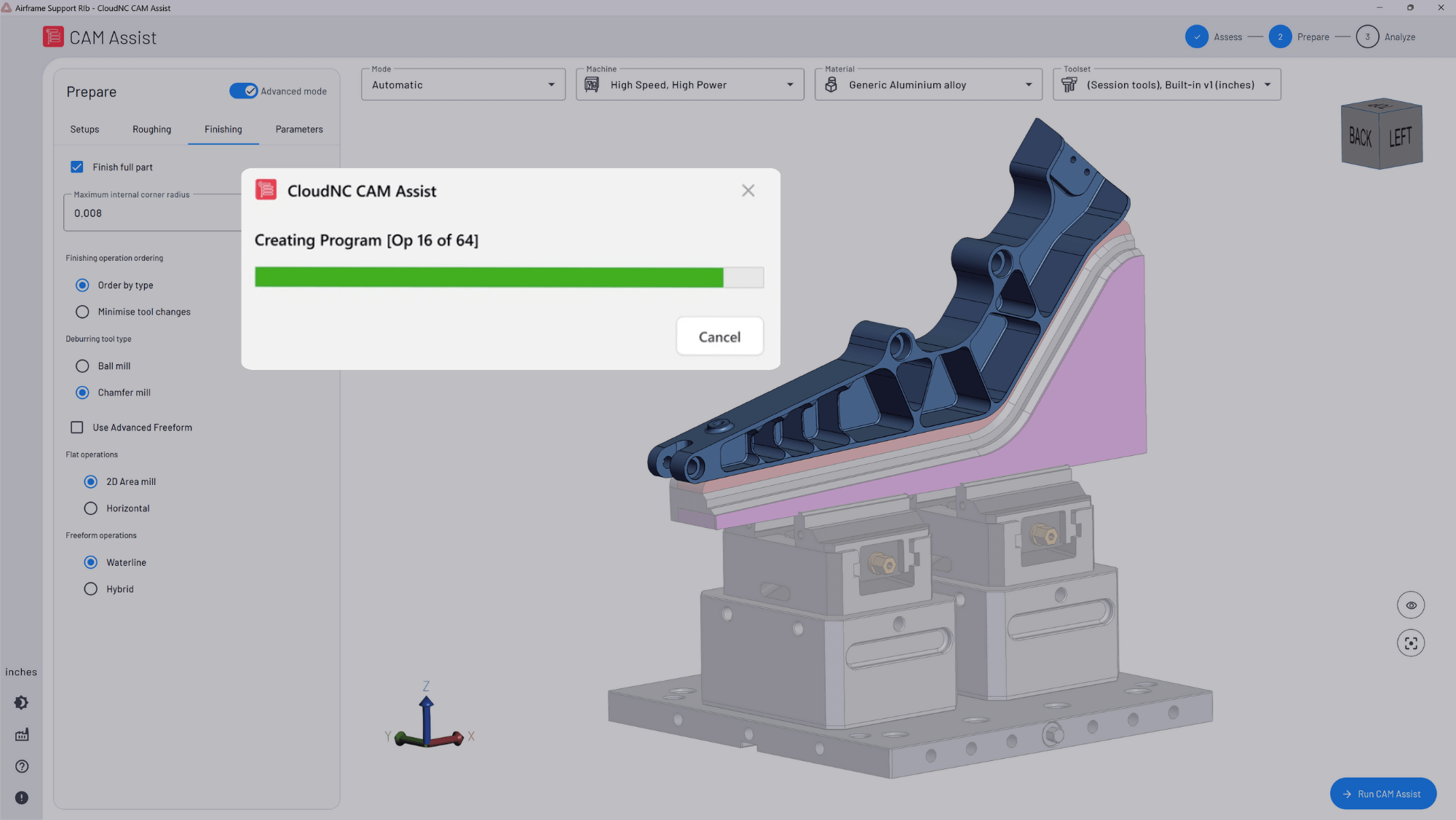
CAM Assist helps shops generate machining strategies and toolpaths inside their existing CAM workflow, reducing repetitive programming effort and helping teams move faster from model to machinable program.
For shops facing the machinist shortage, that means:
- Less dependency on a small number of senior programmers
- Faster turnaround on new jobs
- More consistency across programming output
- More usable output from junior team members
- Better scalability without matching every increase in workload with new hires
The result is not just programming speed. It is operational resilience.
When skilled labor is the constraint, better automation is often the fastest path to added capacity.
AI CAM vs traditional responses to the machinist shortage
Shops still need to recruit, train and retain people. But those strategies solve different parts of the problem on different timelines.
- Hiring
Necessary, but slow and uncertain in a tight labor market.
- Apprenticeships and training
Essential for the long term, but measured in years.
- Wage increases and incentives
Sometimes effective, but often expensive and easy for competitors to match.
- AI-assisted CNC programming
Actionable now, scalable across the current team, and directly tied to throughput.
The strongest strategy is not either-or. It is both-and: keep building talent pipelines while using AI to relieve pressure on today’s programming bottlenecks.
For teams exploring AI-assisted CNC programming, this is the practical middle path between “wait for more talent” and “turn away work.”
What to do next if hiring is limiting your output
If the machinist shortage is affecting your business, start by measuring where the true bottleneck sits.
Ask:
- How many jobs are delayed because programming capacity is full?
- How many quoting hours are lost because senior staff are overloaded?
- How much revenue is limited by unavailable CAM expertise rather than machine availability?
- How much of your team’s programming work is repetitive and standardizable?
If the answer is “too much,” the opportunity is clear: use AI to increase output per programmer.
See how CAM Assist helps shops do more with less headcount → www.cloudnc.com/cam-assist
The CNC machinist shortage in 2026 is not only a hiring problem. It is a capacity problem.
With 433,000 manufacturing job openings still open and up to 2.1 million roles projected to go unfilled by 2030, shops need solutions that work on the timeline the business actually operates on.
Training and apprenticeships remain vital. But when the shortage is already hurting throughput, AI CAM software offers a more immediate lever.
The shops that win will not be the ones waiting for the labor market to normalize. They will be the ones that use AI to make scarce expertise go further.